1992
The collection of the significant Czech journalist, dissident, signatory to Charter 77 and politician, Jiří Ruml, contains both published and as yet unpublished texts from 1967 to 1989, correspondence, Czech and foreign samizdat and exile publications. There are also writings by his friends, many of whom were also important signatories of Charter 77.
The representation of the Revolution in Timişoara through the intermediary of art – twelve monuments created in memory of the heroes of December 1989 – is a project that was launched in 1992 and concluded in 1999 with the erection in a public place of the twelfth monument in this artistic and memorial suite. The project was taken up by the Memorial to the Revolution in Timişoara, which, on the basis of the witness testimonies in its collection, identified the twelve sites of memory where there were victims during the popular revolt. That these twelve monuments were created is entirely thanks to the Memorial, which took responsibility not only for the identification of relevant artistic projects by respected artists in Romania and abroad, but also for their practical execution through the attraction of financial or material support. The inauguration of these monuments to the Revolution of 1989 in Timişoara has the character of an event permanently taking place in the urban spaces of this martyr-city from which the popular revolt started. As Traian Orban puts it, the creation of these monuments was one of the most important missions taken up by the Memorial: “There is here [in the Memorial], also a dimension that calls for the presentation of the Revolution through art. We created a complex of thirteen monuments marking this moment – twelve monuments making up an ensemble of national interest, and the thirteenth here, in the courtyard of the Memorial, as an element marking twenty-five years since December 1989. Twelve sculptors from this country and abroad took part in the execution of this project. The finance for these monuments came from a number of sources: money from donations, from the Ministry of Culture, from the local authorities. The twelve monuments mark the places where people died in Timişoara.”
With regard to the meaning that these monuments have for collective memory, Traian Orban adds: “It’s hard, it’s costly to put up a monument in this country; we managed to put up twelve. It was out of fear that we did this in the beginning: out of fear that there was a desire to erase the traces, a desire for forgetting. Thus, cancellation, forgetting, or even distorting the meanings of the Revolution towards other false targets. We marked these places because it is known that there, and there, and there, in twelve particular places, people died. They died for freedom, for a better, more dignified life, for democracy.” And he adds that, with the same purpose of resisting forgetting, the institution that he heads has added a museum dimension to the area of Popeşti-Leordeni near Bucharest, where a part of the dead of Timişoara were transported to be incinerated and for their traces to be lost: “We also put up a church-monument at Popeşti-Leordeni. At the back, a visiting place is the sewer hole – where the ashes of the martyrs were thrown. To make things clear, the names of the incinerated martyrs are also given there, for the completely erroneous claim keeps being made that they were foreign agents and unknown persons. No! They were citizens of Timişoara, killed by the communists in December 1989. There was a wish to erase their traces, by order. And quite a lot of traces were erased – they removed bodies, they destroyed hospital documentation, they incinerated bodies at the crematorium, and they took the ashes there, to Popeşti-Leordeni.” As for the thirteen monuments (twelve plus one) in the urban space of Timişoara, these have the status of open works of art through the intermediary of which the Memorial to the Revolution in Timişoara marks the memory of the Romanian Revolution. In connection with the thirteen monuments in the city of Timişoara, Gino Rado draws attention to a recent pedagogical dimension: “Until recently we made pilgrimages to the monuments in the city, the twelve I have told you about. Now we have partnerships with the schools – they have adopted the monuments. Each monument belongs to a school – well, every year they come and make pilgrimages to these monuments. They are the schools that are situated closest to one or other of the monuments. And these acts of homage are made every year, in December. It’s something beautiful and it’s another way of not forgetting.”
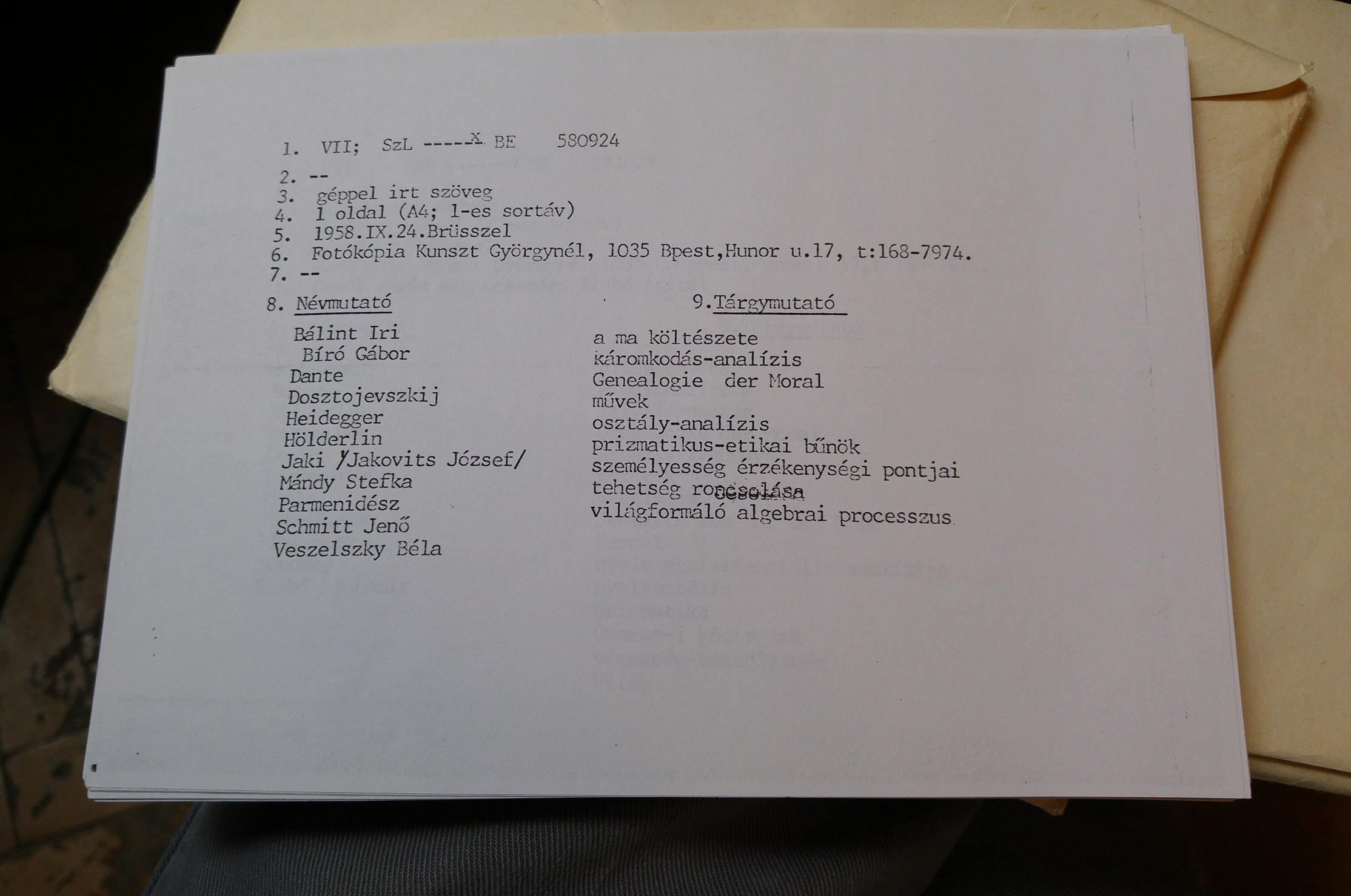
This index was created during the systematization of the oeuvre of Lajos Szabó, following the principles worked out by György Kunszt. It specifies a surprisingly long list of names and subjects compared to the length of the whole document, one typed page, created during the second year in emigration. It lists many names from their circle of friends in Budapest (but not only them). The list of subjects includes promising items, as “analysis of damnation” and “Genealogie der Moral.” It is a nice coincidence that the word “destruction” appears smudgy on the paper.
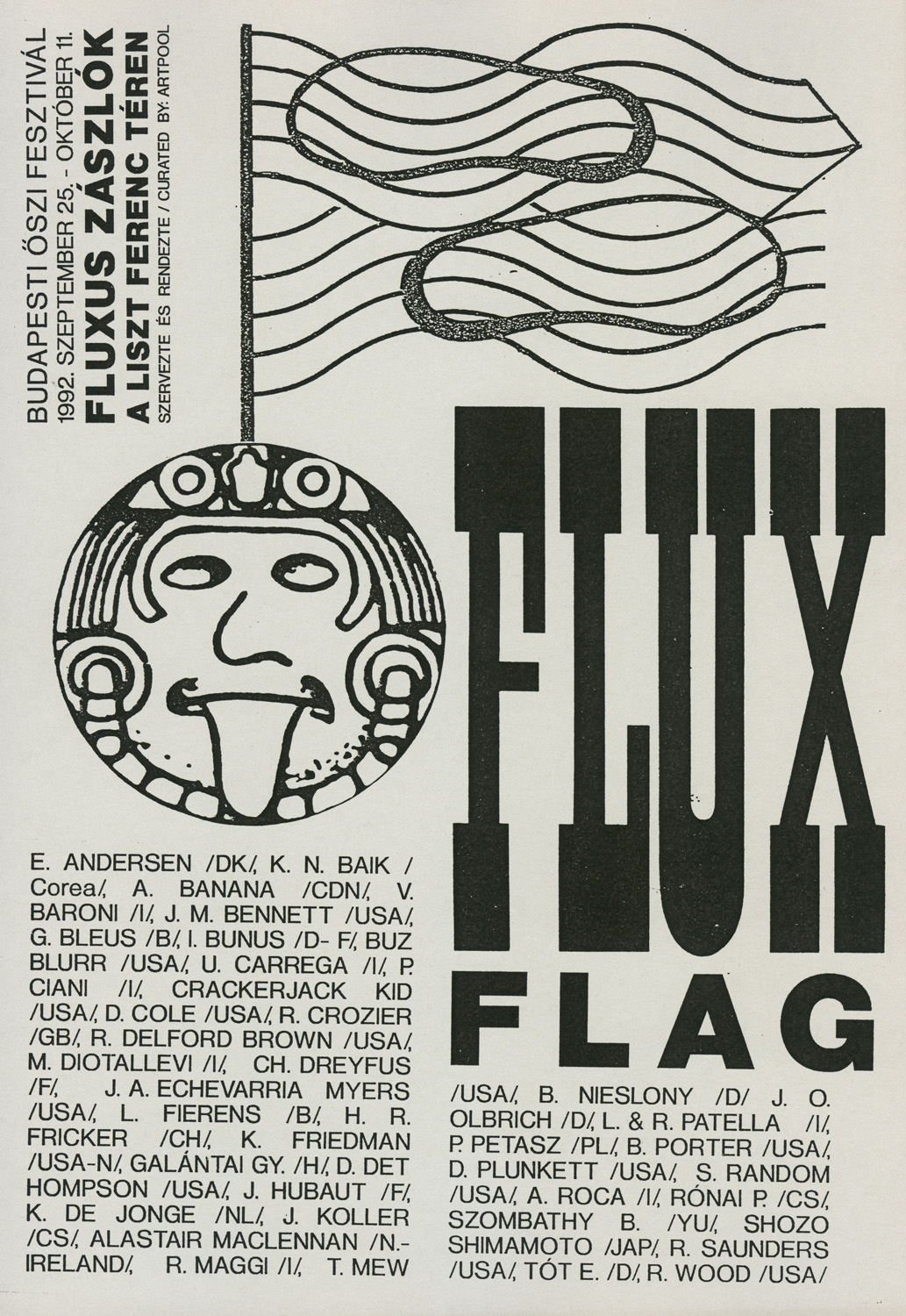
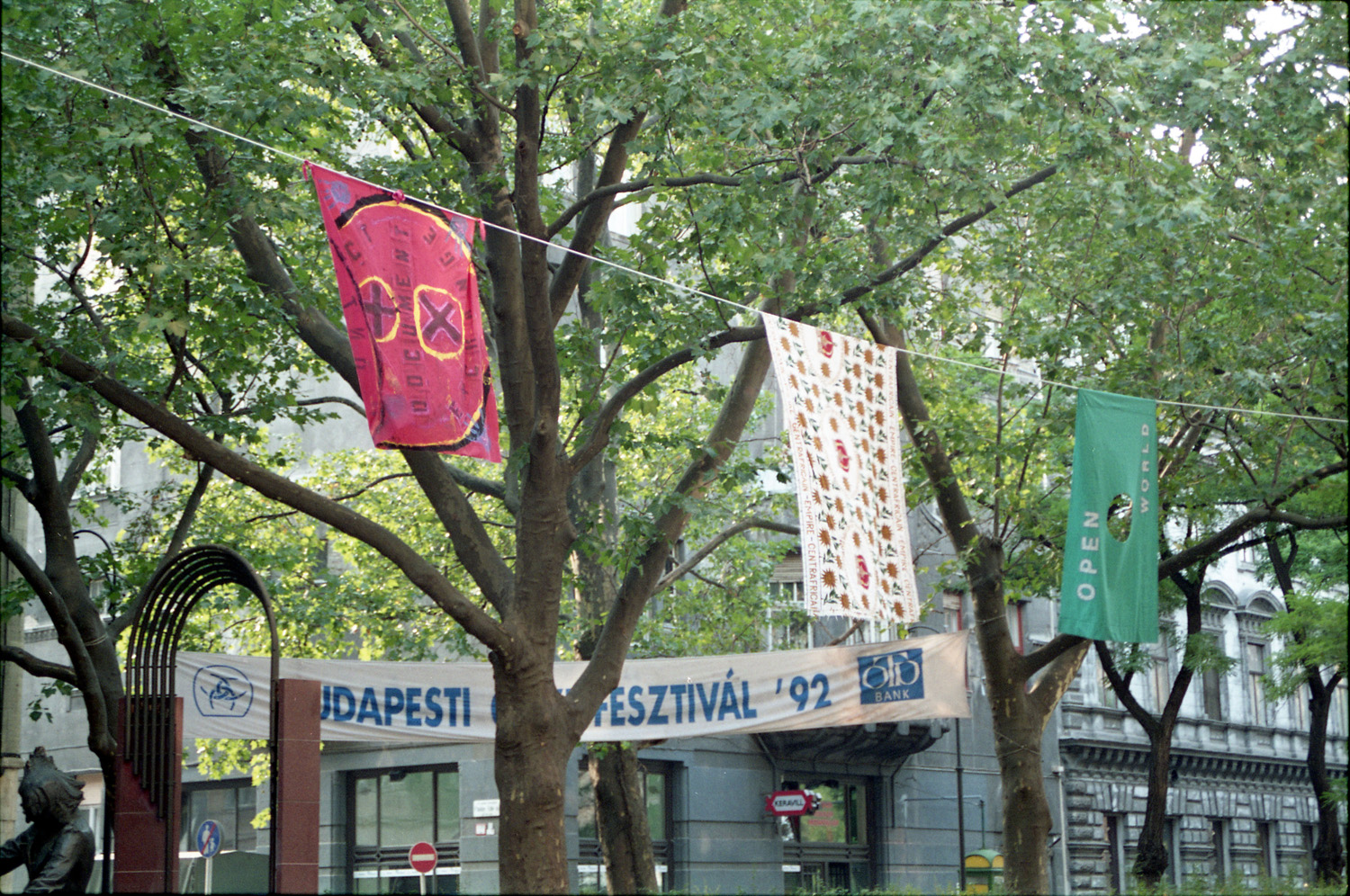
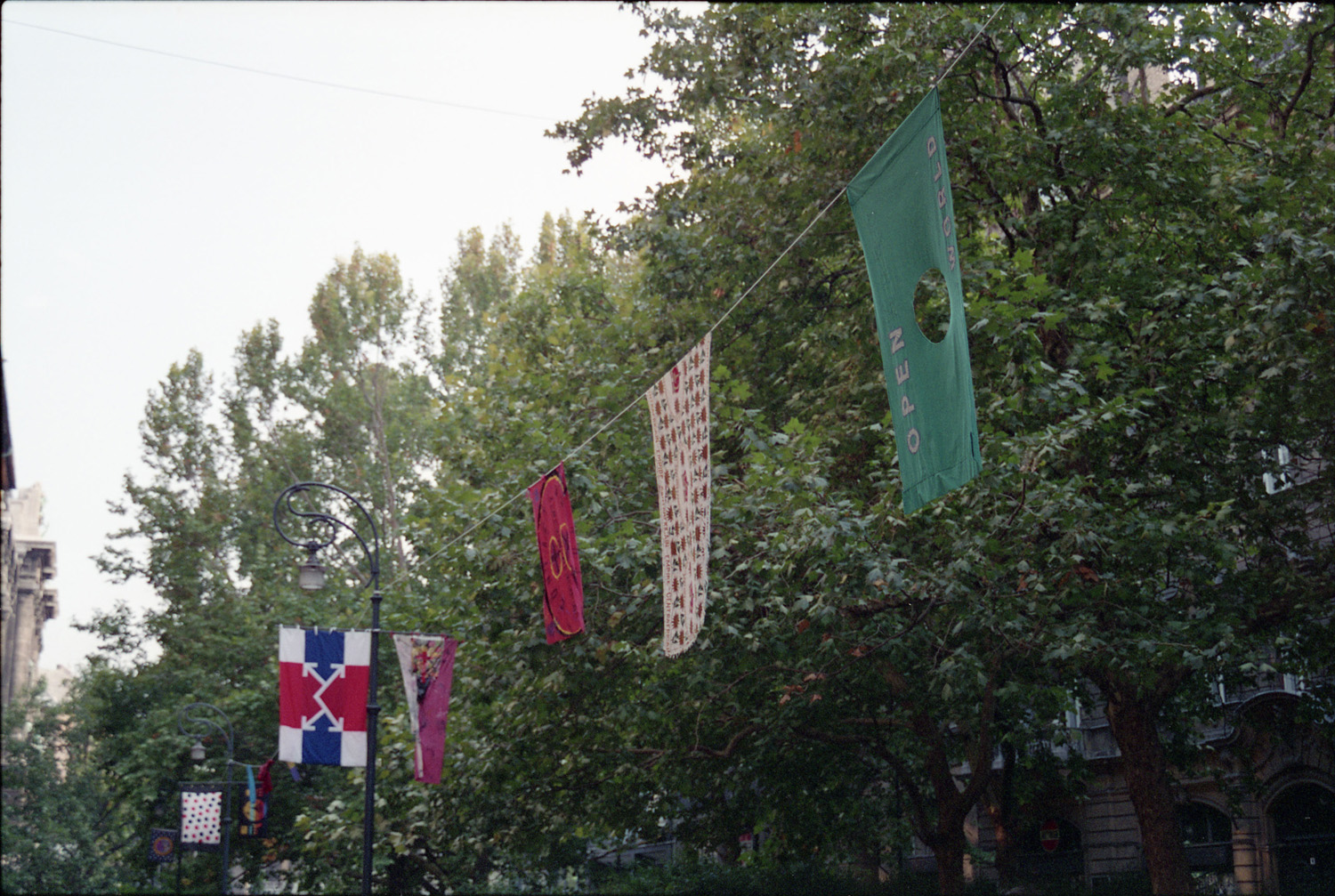
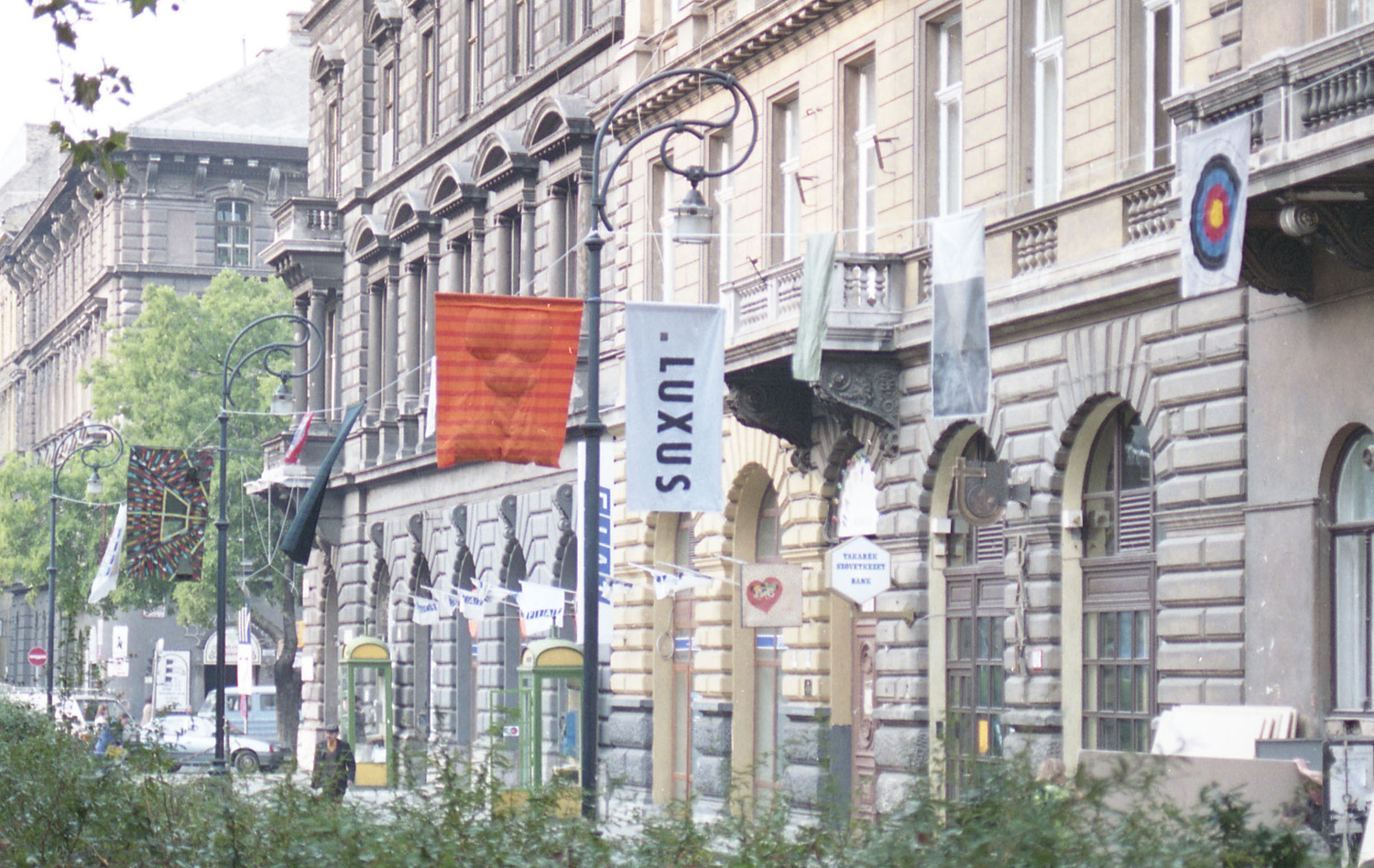
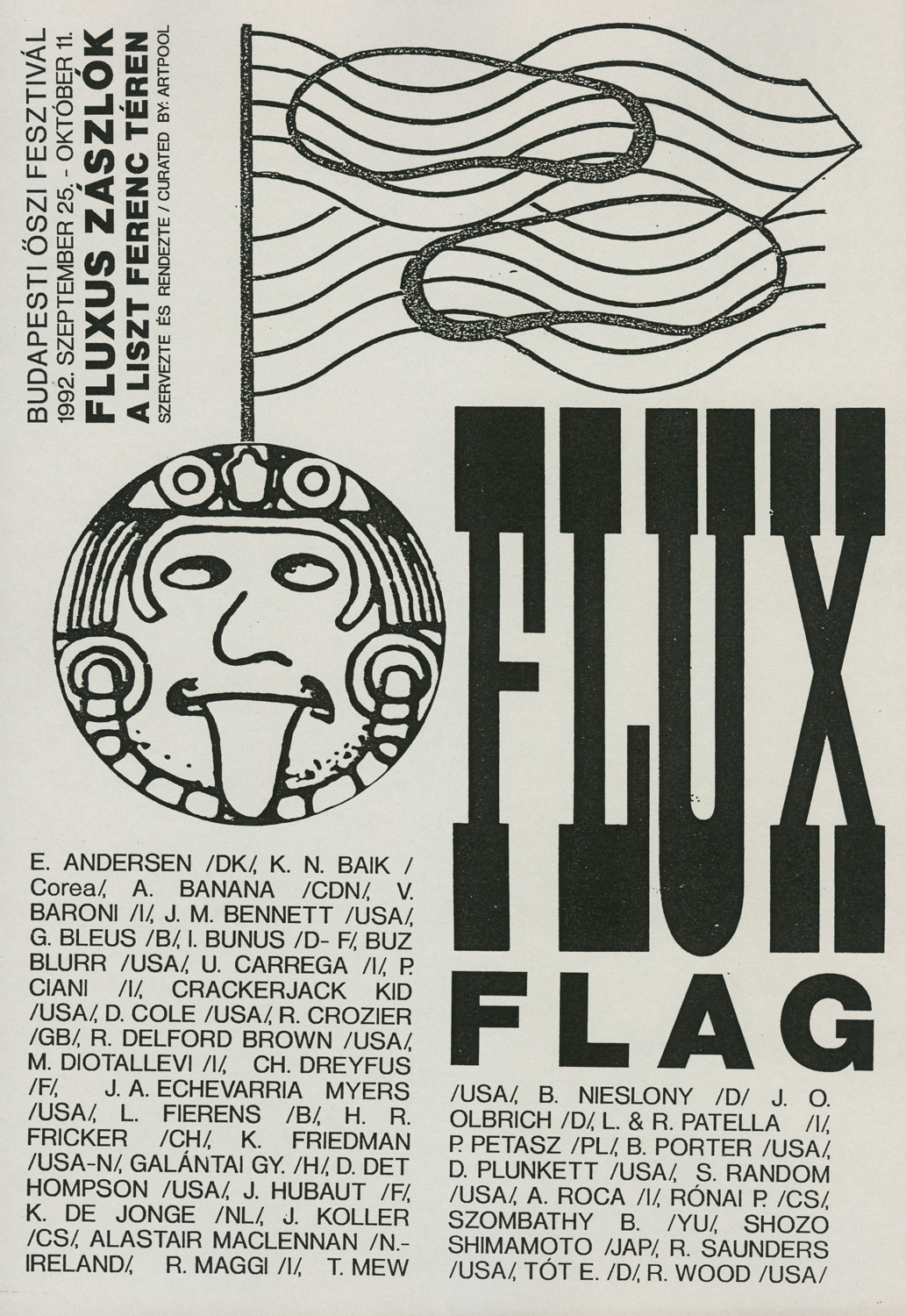
(Liszt Ferenc square, Budapest, September 25-October 11, 1992)
The open-air exhibition was realized in the frameworks of the Budapest Autumn Festival in 1992. Artpool invited 100 artists to commemorate the 30 years of the Fluxus movement. 42 artists from 18 countries responded to the call and participated in the exhibition being organized on Liszt Ferenc square – the new location of Artpool Art Research Center – by sending their Fluxus flags. The open-air show was opened by György Galántai who executed a Fluxus event of Ken Friedman. The exhibition was accompanied by a bookwork catalogue documenting it. The Fluxus flags were also presented in Marseille in 1993 and at Artpool P60 in 2000.http://www.artpool.hu/1992/920925e.html
http://www.artpool.hu/Fluxus/flag/index.html
Photographic negatives and 62 volumes of the Chronicle were obtained after the KGB left its building following the collapse of the Soviet Union. The Museum of Genocide victims was established in one part of the building, and its staff found volumes of the Chronicle left on shelves and desks. The KGB had acquired these volumes during its operations against the Catholic opposition.
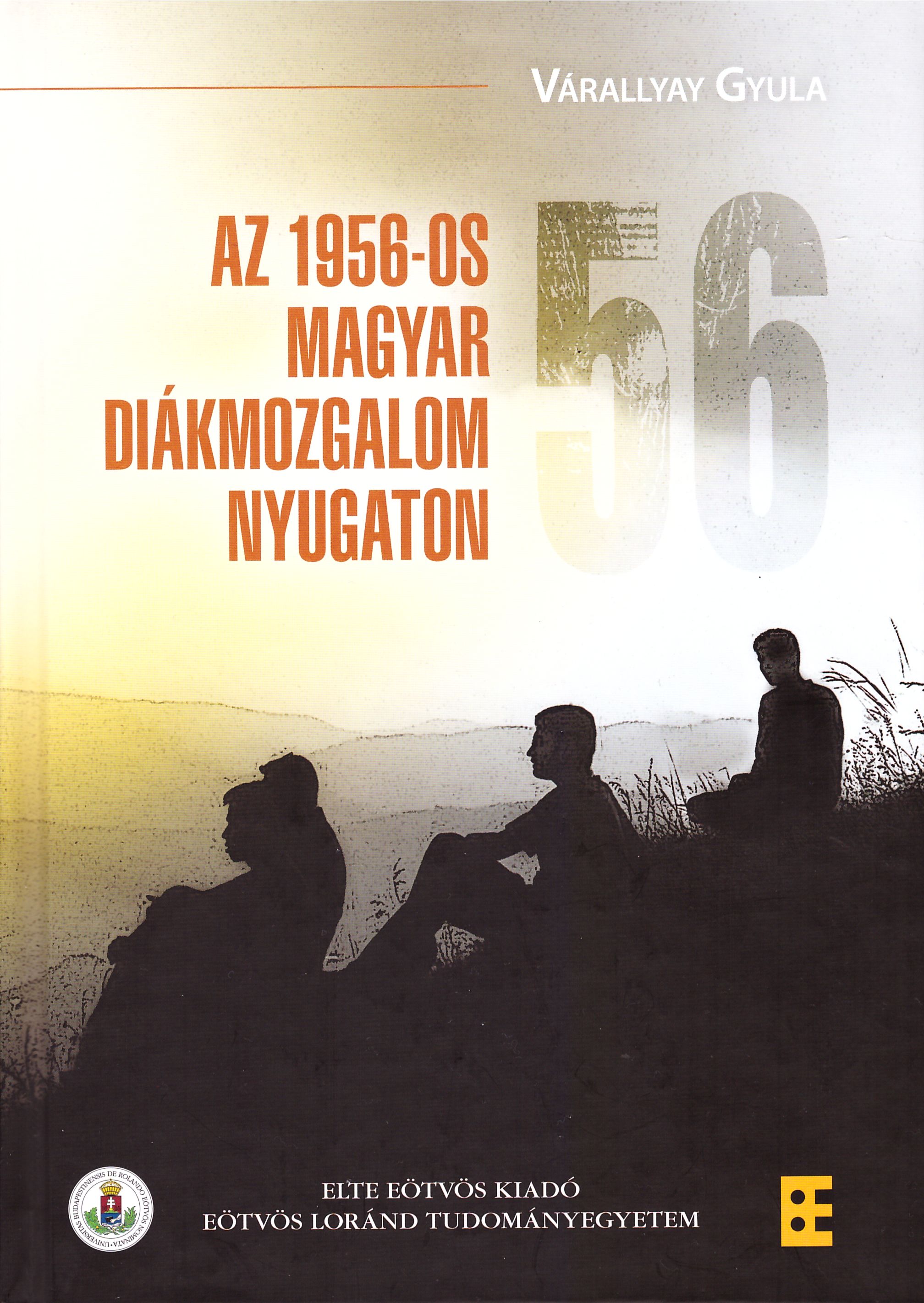
Gyula (Julius) Várallyay's first book on the history of the Hungarian émigré student movement, UFHS-MEFESZ (1957-1967), was published in Hungarian in Hungary and the West with the same contents and title: Tanulmányúton. Az emigráns magyar diákmozgalom 1956 után.” (Századvég Alapítvány - 1956-os Intézet; Occidental Press) While working on the manuscript between 1986 and 1988, Váralllyay sent a circular to his one-time fellow-students all over the world asking them to provide him with further resources concerning UFHS-MEFESZ. Many of the people to whom he addressed this request helped make his collection complete by sending him a large amount of data and many archival papers.
(Presented at Fluxus Flags on the Liszt Ferenc square, Liszt Ferenc square, Budapest, September 25-October 11, 1992)
The flags as Fluxus objects were realized as responses to the announcement in which Artpool invited 100 artists to participate in the commemoration of the 30th anniversary of Fluxus. Artpool received responses from 42 artists from 18 countries, whose flags were presented in the open-air exhibition on Liszt Ferenc square. Flags by Eric Andersen, Anna Banana, Vittore Baroni, Reid Wood, Július Koller, Bálint Szombathy, Endre Tót, etc. were being shown.http://www.artpool.hu/Fluxus/flag/index.html
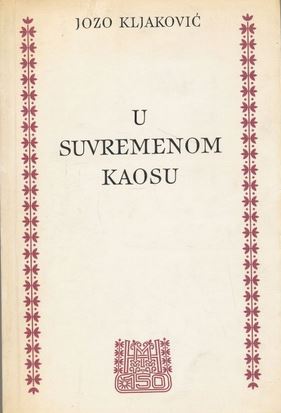
Kljaković, Jozo. U suvremenom kaosu: uspomene i doživljaji [In the Contemporary Chaos: Memories and Experiences]. 1992, Book.
In this book, Kljaković recounted his memories of the turbulent political events of his life. As a civic intellectual and defender of the values of Western civilization, he was especially concerned about the rise of communism in his country and the world after the Second World War. The book was not available in Croatia and Yugoslavia until 1990 due to Kljaković's criticism of the socialist regime. It was originally published in Buenos Aires in 1952, and the Croatian edition was published only in 1992 after the collapse of communism. Kljaković particularly emphasized his connections to the Yugoslav Partisan movement in the second half of the WWII during his exile in Italy. He described his break with it and expressed a deep scepticism in the success of the post-war project of the new Yugoslavia, pointing out that "Tito's attempts to organize Yugoslavia as a federation and to subordinate the national and religious aspects to the social ideology of “The Internationale” does not solve our problems" (Kljaković 1992: 282). According to Dukić, Tito himself told his associates that this book should not be translated into English.
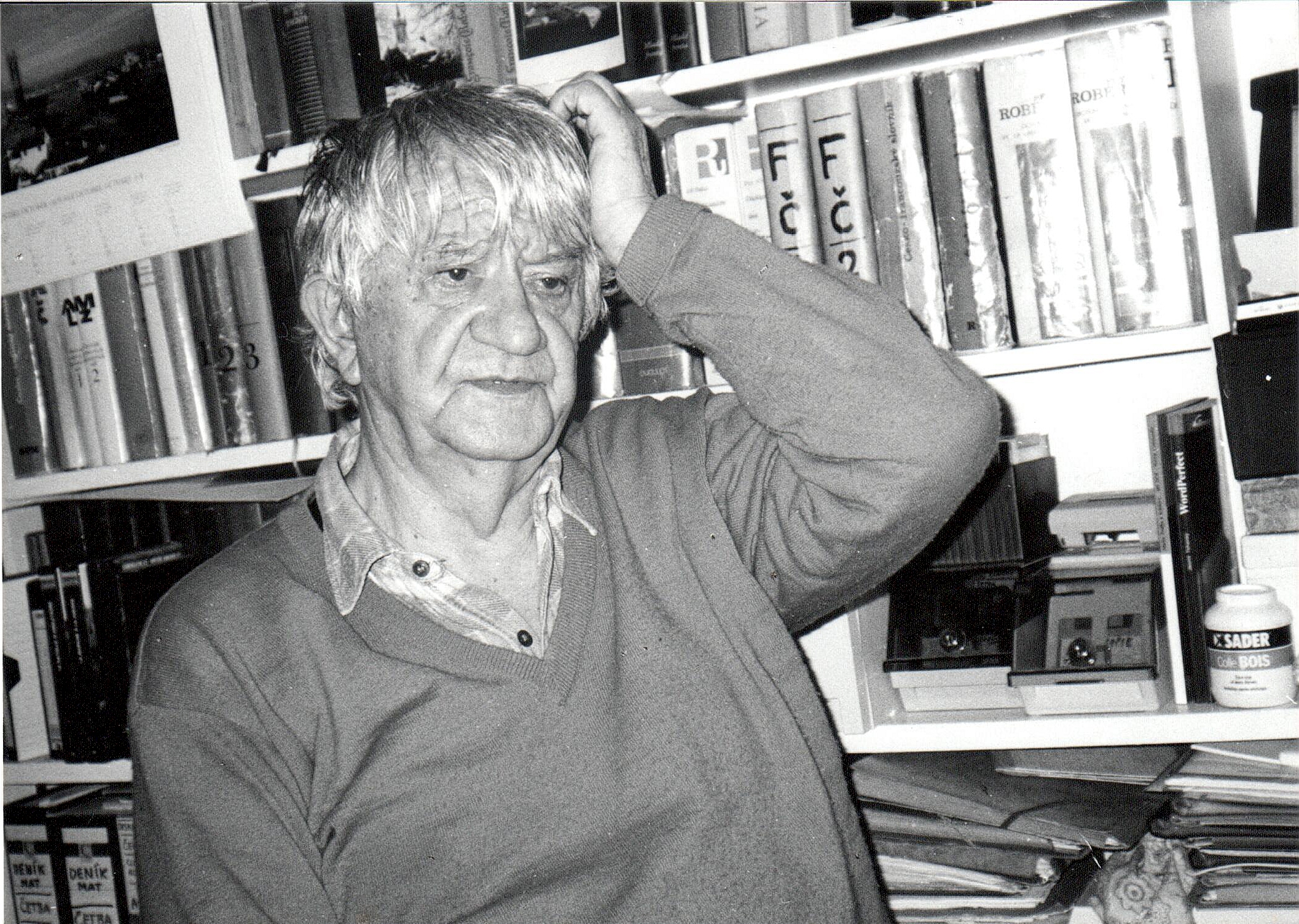
Jan Vladislav (1923–2009) was a Czech poet, translator and signatory of Charter 77; he was forced to emigrate from Czechoslovakia in 1981 and later lived in France. He was visited there by a film crew from the Literary Archive of the Museum of Czech Literature in the summer of 1992, as part of the Authentic project and the Independent Documentary Centre of Aleš Záboj. On this occasion, a video recording of Jan Vladislav being interviewed by Petr Kotyk in his study was made on 6 August 1992. Jan Vladislav recalled his activities in Czechoslovakia before his emigration and also mentioned the importance of translators, whose work made it possible to “promote both classic and modern authors, whose work was liberatingly defying the official Czech cultural politics through its spirit, content and mission”. He was talking also about the cultural repression in Czechoslovakia after 1948, de-Stalinization, the Prague Spring and role of intellectuals in the twentieth century. Apart from this video recording of the interview between Jan Vladislav and Petr Kotyk, the recordings of Vladislav’s own public appearances as well as conferences concerning him are also deposited in the video and audio library of the Literary Archive of the Museum of Czech Literature.
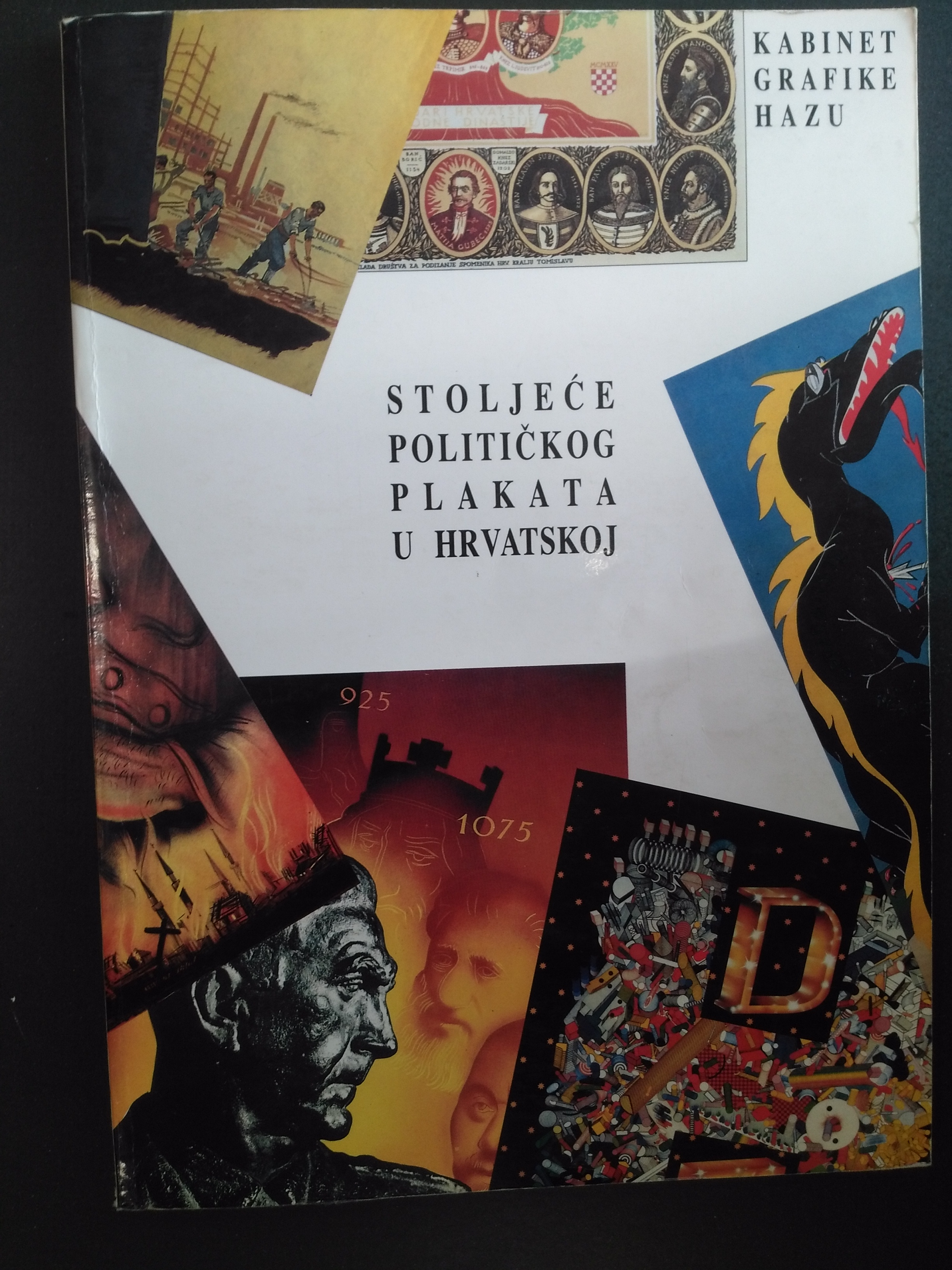
The exhibition called “"A Century of the Political Poster in Croatia”" was organised by the Department of Prints and Drawings at the Croatian Academy of Sciences and Arts, June–July1992, two years after the first parliamentary elections were held in Croatia, when political propaganda became a popular topic thanks to the new multi-party system. The exhibition included the material entitled “The collection of forbidden leaflets etc. from the period 1931 to 1941” from the Iljko Karaman Collection, referred to in a short note in the Box 1.